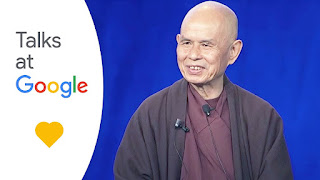
Showing posts with label Thich Nhat Hanh. Show all posts

Sunday, August 6, 2023

[5] Thich Nhat Hanh @ Google HQ: Pain & Suffering / Strong Emotions / Success / True Love

Mindfulness as a Foundation for Wellness: Part 5
Previous: Part 1 / Part 2 / Part 3 / Part 4

SOURCE in the public domain HERE  

Here is the last part of the transcription of Thich Nhat Hanh’s talk at Google Headquarters in September 2011. This is what the great Zen teacher wanted most to convey to folks working at one of the world’s most dynamic and innovative tech companies. We can say, therefore, that it is Thich Nhat Hanh’s heartfelt message to us who live in a busy, hectic, and constantly changing world driven by the ubiquitous advanced technology that plays a crucial role in everything today. Special thanks to my research assistant Christine Atchison for helping me out in this project.


Dealing with pain and suffering / Generating happiness and joy, here and now

Practice (i.e., Buddhist practices) helps us to touch the conditions of happiness in the here and the now so that we can generate a feeling of joy at any moment we want. And that is not too difficult. If you go back to your body, if you bring your mind home to your body, and establish yourself in the here and the now, you will realize that conditions for your happiness are more than enough. And happiness is possible right in the here and the now. So, to generate a moment of joy is possible, to generate a moment of happiness is also possible for a practitioner no matter where and when. And the practice of mindfulness also helps us to recognize a painful feeling [or] a painful emotion when they manifest. [With regard to] a painful feeling, we have a tendency to try to run away from it. We want to cover it up by consumption.

If we listen to music, if we read magazines, if we eat—maybe it’s not because these things bring us a lot of happiness but because we don’t want to get in touch with the suffering; we want to cover it up with consumption. Obesity is an outcome of that. You have a feeling of loneliness, despair, anger, worries in you and you don’t know how to handle those … and that’s why you want to forget; [you want] to run away, and one of the ways is to just consume—some music, magazines, food … [These things] are there in order to help you to cover up your suffering. You do not solve your problem [though]. But the practice consists in going home and taking good care of that pain. Breathing in, I am aware of the painful feeling in me. There is the energy of pain of course, but, as a practitioner, you generate the energy of mindfulness and concentration. And with the second energy you recognize the first energy. [You can say:] Hello there my little pain! I know you are there. I will take good care of you. So, like a mother holding her baby when the baby suffers, the practitioner generates the energy of mindfulness and concentration and go[es] home and take[s] care of the painful feeling, of the painful emotion in him or in her and get[s] that relief. (1:16:44).

On Weathering Strong Emotions

[There are] so many young people who are not capable of handling a strong emotion, and they believe that the only way to stop suffering is to go kill themselves. That is why so many young people commit suicide everywhere. But we know very well that an emotion whether it is strong [or] however strong it is, is only an emotion. … and we are much more than an emotion. An emotion is something that comes and stay[s] for some time and finally goes [away]. Why do we have to die because of just one emotion? That is what you can remind yourself when an emotion manifests in you.

And if you know the practice of mindful breathing/mindful walking, generating the energy of mindfulness, you can very well recognize and embrace that emotion and you are safe. An emotion is like a storm coming and there are ways in order to stand and not to allow the storm to blow you away. The practice of deep breathing in a position of sitting or lying down focuses your attention on the rise and fall of your abdomen, and just that. Stop all your thinking, because the more you think the stronger the emotion can become. Stop the thinking! Bring your mind down to the level of your navel, breathe in deeply, and become aware of the rise and fall of your abdomen. Stay in that position and continue. [If you do those exercises,] your emotion cannot, will not be able to do anything to you. And after five minutes, ten minutes, or even half an hour, the emotion will go [away] and you will survive it. The next time it comes, you will [do] just that. It’s easy enough. You should train yourselves only a few times. And everyday if you know how to do it, try a few minutes. And then after a few weeks it will become a habit. And when that emotion manifests you will remember to practice and you are no longer afraid of an emotion (1:19:44).

Saturday, May 27, 2023

[4] Thich Nhat Hanh @ Google HQ: Mindful Practices During the Day / Store-Consciousness / "Not Thinking"

 Mindfulness as a Foundation for Wellness: Part 4

Click for Part 1 / Click for Part 2 / Part 3 / Part 5


Source in the public domain of this video is HERE

Here is the continuation of the transcription of Thich Nhat Hanh’s talk at Google Headquarters of September 2011. This is what the great Zen teacher wanted most to convey to folks working at one of the world’s most dynamic and innovative tech companies. We can say, therefore, that it is Thich Nhat Hanh’s heartfelt message to us who live in a busy, hectic, and constantly changing world driven by the ubiquitous advanced technology that plays a crucial role in everything today. Special thanks to my research assistant Christine Atchison for helping me out in this

How to incorporate short mindful moments into your daily routine

Eating [47:30]

When you eat your breakfast, you have a chance to practice [the] mindfulness [of] eating. You don’t have to think about your projects, your work. Every moment of breakfast is an opportunity for us to get in touch with the wonders of life. Today we will have a chance to share a meal together in mindfulness. Holding a piece of bread, you might like to stop your thinking and look deeply into the piece of bread.

Mindfully, you breath in and might get in touch with the fact that the piece of bread that you are holding contains the whole universe. There is the sunshine that helped the wheat to grow; there is the cloud that provided rain for the wheat to grow; the earth is in there—time, space, and everything in the cosmos has come together in order to produce that piece of bread. And that insight you can get in just a few seconds of looking mindfully at that piece of bread.

If you keep thinking about the past, or the future, or your projects, you miss the bread. You miss the Kingdom of God that the bread is bringing to you. And when you put the piece of bread you might like to enjoy just chewing the bread—getting in touch with the wonders of life instead of chewing your projects, your worries, your fear. You stop all your thinking. You just enjoy eating your breakfast. And that is practice. You don’t need to set aside time for practicing.  [49:54]

Taking a Shower, Brushing Our Teeth

When you take a shower, that is time for practic[ing] mindfulness. You might enjoy your mindful breathing and become aware of the water, of your body, and you can create joy and happiness while taking a shower. The essential [thing] is to stop thinking. The thinking will carry you away and [will not] allow you to live that moment of life.

René Descartes said ‘I think therefore I am’. I’m not very sure of that because if you think so much you will go around your thinking. Your thinking might not be productive at all. It will carry you to many realms and make you worry more and angrier and so on. So, if you are carried away by your thinking, you are not there. That’s why: [perhaps it’s better to say] I think therefore I am not there. It’s better to stop the thinking in order to be there.

When we brush our teeth, we might choose to brush our teeth in such a way that makes freedom and joy and happiness possible during the time of brushing our teeth. It may take two minutes or three minutes. The essential is to stop your thinking, even if you have a lot of things to do. Stop your thinking and enjoy brushing your teeth. When I brush my teeth, I usually touch on the fact that I am over 80 and still have some teeth to brush and it is enough to make me happy.

Brush your teeth in such a way that freedom is possible. Joy and happiness are possible during the time of toothbrush. That is a challenge and I know you can do it. Do not think about your work, your projects. Just enjoy being there and brushing your teeth. That moment  … you can live it deeply also because you can always touch the wonders of life, the Kingdom of God in the here and the now.

We used to distinguish between time for work and free time. Buddha has changed our way of thinking. Suppose you have free time, some free time. And if you do not know how to make use of your free time your time is not really free. If you keep thinking and worrying, that time does not make you happy. That time is not for working, of course, but you continue to think about it; you continue to worry about it. And that thinking is not productive. (54:13).

Sunday, March 20, 2022

[3] Thich Nhat Hanh @ Google HQ: Loving Yourself / Four Mindfulness Exercises from the Buddha

Mindfulness as a Foundation for Wellness: Part 3

Click for Part 1 / Click for Part 2 / Part 4 / Part 5

Source in the public domain of this video is HERE

Here is the continuation of the transcription of Thich Nhat Hanh’s talk at Google Headquarters of September 2011. This is what the great Zen teacher wanted most to convey to folks working at one of the world’s most dynamic and innovative tech companies. We can say, therefore, that it is Thich Nhat Hanh’s heartfelt message to us who live in a busy, hectic, and constantly changing world driven by the ubiquitous advanced technology that plays a crucial role in everything today. Special thanks to my research assistant Christine Atchison for helping me out in this

[27:40]

[1] Why loving and caring for yourself is the foundation of loving and caring for others

     That presence generated by the practice of mindfulness, of breathing [during] your walk, that presence is for you first (for us first), and then for the other person. We have to be truly present because love always begins with oneself. If you are not capable of loving yourself, of taking care of yourself, you will not have the capacity to love the other person and take good care of him or her. And that is why loving oneself is the foundation of loving the other person. And there are practices everyone can do in order to care for oneself, in order for us to be able to care for the other person and for the world. (28:45).

[2] Four Simple Meditation Exercises from the Buddha

[2.1] The First Exercise: Being Aware of Your In-Breath and Out-Breath

     The Buddha proposed many easy, simple practices that everyone can do. Like the first practice of mindful breathing [or] exercise of mindful breathing: Breathing in, I know I am breathing in. Breathing out, I know I am breathing out. You recognize your in-breath; you recognize your out-breath. And since you have your in-breath as an object of your mind you release everything else, you are free. A very simple exercise and in fact it’s great: it sets you free—just three, four seconds of breathing in. And you don’t need to practice many months and many years in order to see the effect. The first few minutes when you begin the practice you can see the outcome right away. Breathing in, if you pay attention only to your in-breath and then you can release the past, the future and all your projects (that is, pay attention to the present) and the process of healing begins right away.

[2.2] The Second Exercise: Following Your In-Breath and Out-Breath All the Way

     The second exercise on mindful breathing is: breathing in, I follow my in-breath from the beginning to the end. I follow my in-breath all the way through. Your in-breath may last only three or four, five seconds but while breathing in, you are fully concentrated on your in-breath and you may enjoy breathing in because breathing in is something enjoyable too. You don’t have to suffer while breathing in. If you suffer while breathing in, you are not practicing correctly.  Because life, there is a lot of suffering already in life, why do you have to practice in order to suffer more? So, whether it is the practice of mindful breathing, or mindful walking, or mindful sitting, we do it in such a way that it gives you pleasure and happiness. The practice is pleasant; [it] should be pleasant.

The Energies Generated by Mindfulness

     And when the energy of mindfulness and concentration is powerful enough, you always get an insight. The insight, that insight can help liberate you from your afflictions, like fear, anger, or jealousy, despair, and so on. There are three kinds of energies that can be generated by the practice of mindfulness. [1] The first energy is [the kind of] mindfulness which allow us to become alive, to become present in the here and the now and to be aware of what is happening in the here and the now. [2] And the second energy is the energy of concentration—when you are very aware, when you are very mindful of something, you are naturally concentrated on that. If you’re aware, if you are mindful of your in-breath, you get concentrated on your in-breath. So that is the meaning of the second exercise: breathing in I follow my in-breath all the way through. So mindfulness become powerful because of the concentration that is born from the practice of mindfulness. And when mindfulness and concentration are together, are powerful enough, you always get the third energy—[3] the energy of insight. (33:13).

The Miracle and Joy of Being Alive

     Insight in this case does not come from thinking, but from mindfulness and during the time of practicing mindfulness and concentration, you don’t need to think. You might like to stop the [process of] thinking all together. Insight has an outcome of non-thinking. When you breath in mindfully, and with concentration, you might discover many things. You might discover the fact that we are alive. Many do not know that they are alive. They are there but they are not alive because they do not have mindfulness. So, there is a very simple exercise: breathing in mindfully I feel alive. This is the truth—if someone is not alive, she cannot breath in anymore. So, breathing in mindfully, you get an insight that you are alive. And to be alive is the most wonderful thing. It is a miracle; it is the greatest of all miracles to be alive. And just two or three seconds [or] breathing in can bring you the insight that you are alive. And you touch the miracle of being alive and when you breath out you can celebrate the fact that you are alive.

     So, happiness is possible; joy is possible just by one in-breath and one out-breath. And it’s nourishing and healing. And breathing in mindfully like that helps you to touch the many conditions of happiness that have the power to heal and to nourish us and [those] around us. Suppose we breath in and we become mindful of our heart. Breathing in I am aware of my heart. Generating the energy of mindfulness, you use that image of mindfulness to recognize the presence of your heart. You kind of embrace your heart with the image/energy of mindfulness and you can discover the fact that your heart still functions normally. That is already an insight. And it’s wonderful to have a heart that still functions normally. There are those of us who are/can only wish for that, and their deepest desire might be just having a heart, a normal heart like that. So, breathing in and having our heart as the object of our mindfulness we can feel grateful to our heart and that is one of the conditions of happiness that we are having.

Being in Touch with our Body

     And when the Buddha teaches the practice of mindfulness of the body, he advises us to get in touch with parts of the body and smile, recognize these parts of the body. There is an exercise of deep, total relaxation that we will try today. We put ourselves in the lying position and we begin to breath in and out mindfully and recognize parts of our body. It’s like scanning our body not with an x-ray but with a ray of mindfulness. You recognize your eyes: breathing in I am aware of my eyes. Breathing out I smile with my eyes, recognizing the presence of your eyes. And you might get the insight that, well, my eyes are still in good condition. A paradise of forms and colours are easily available to me just because I still have eyes in good condition. You need only to open your eyes in order to touch the paradise of form and colour. That is another condition of happiness. And we go through the body, and we recognize every part of the body. And we come to a place that is a little failing we might like to stop longer and embrace with compassion and tenderness that part of the body that is ailing. That practice of being aware of the body can help heal the body. You can still continue with the medicine, but to relax our body, to embrace tenderly that part of our body with mindfulness practice can accelerate, can help very much [with] the healing, can make the healing happen more quickly. (39:31).

 [2.3/2.4] The Third & Fourth Exercises: Being Aware of Your Body and Releasing Tension

     The third exercise—breathing in I am aware of my body—is part of that exercise. And the fourth exercise is: breathing in, I release all the tension in my body. The body has the power to heal itself only if you allow it to do that. When an animal in the forest gets wounded, deeply wounded, she knows what to do. The animal finds a quiet place and lays down. She knows deeply that resting is the only way to heal. The animal does not think of looking for food or running after an animal. She knows that the best thing is to rest like that because the body has a natural tendency, a natural power to heal itself. We human beings used to have that kind of wisdom, but we have lost our capacity to rest. We have worked our body too hard. We have accumulated a lot of tension in our body and make it more difficult for our body to heal. We only count on medicines and other kinds of means. So, the fourth exercise of mindful breathing is very helpful. It helps us to be aware of our body and our mind become(s) embodied again and helps the body to release the tension. And when the tension is released, the body recovers that capacity to heal itself. So, the practice of mindful sitting with concentration, the practice of mindful walking, the practice of mindful breathing while lying down can be very helpful—it can heal.

The Role of the Sangha (the Community)

     And we do not have to set aside time in order to do that. Just as I said, walking from the parking lot to the office, you have time to practice releasing the tension and enjoying every step and in-breath and touching the Kingdom of God around you and inside of you. The only thing is that there should be someone to remind you to do it. You might understand it perfectly, but you don’t do it. We live as a community. Our root practice centre is in France, but in North America we have Deer Park Monastery in Southern California, Escondido. And we have the Brooklyn practice centre in the State of New York. And we live as a sangha of monks, nuns, and lay-practitioners and we practice together, and we remind each other to practice. When we listen to the bell, well hundreds of us listen to the bell together. When we sit together and work together, we do that together. And breathing together, walking together, sitting together, we generate a very powerful quality of energy of mindfulness, concentration, and compassion. (44:14).

     And that helps heal us. When you find yourself in an environment filled with that kind of energy—peace, mindfulness, compassion—you get the healing very easily and quickly. I think a corporation can organize [itself] also as a practice community. There are times when you can sit together, can breath together, can work together, release the tension together and then together we can generate that kind of collective energy that is very nourishing and healing. Our retreats of mindfulness are always attended by teenagers and children and there are practitioners who bring their babies (although the babies do not understand the Dharma Talk), they find themselves in an environment that is so peaceful, so compassionate, they get the nourishment, they feel it. So, everyone can profit from the practice.

     In the practice centre, when you need to move from one place to another place, you always apply the techniques of mindful walking no matter how short or how long the distance is. The practice is to arrive in the here and the now with every step and touching the wonders of life with every step. And while we walk, we do not talk, and we do not think. When we stop our thinking and our talking, we touch life more deeply so that we can get the nourishment and the healing. And when [gestures to the bell silently during a pause] let us enjoy breathing together. (46:49).

[the bell rings and the speaker and audience silently breath until 47:30]


---


Sunday, March 13, 2022

[2] Thich Nhat Hanh @ Google HQ: Walking Meditation / Cultivating Beauty, Stability, Right Perception, and Freedom

 Mindfulness as a Foundation for Wellness-Part 2

 (To go back to part 1, click HERE)

Part 3 / Part 4 / Part 5

from Talks at Google

SOURCE in the public domain HERE

Also on the ‘Talks at Goggle’ channel: https://www.youtube.com/watch?v=Ijnt-eXukwk&list=PLV7Diz4DTv4nv-RTpS-0QuDNHUh0b1OLP&index=1&t=6049s

Here is the continuation of the transcription of Thich Nhat Hanh’s talk at Google Headquarters of September 2011. This is what the great Zen teacher wanted most to convey to folks working at one of the world’s most dynamic and innovative tech companies. We can say, therefore, that it is Thich Nhat Hanh’s heartfelt message to us who live in a busy, hectic, and constantly changing world driven by the ubiquitous advanced technology that plays a crucial role in everything today. Special thanks to my research assistant Christine Atchison for helping me out in this.

***

[1] The Practice of Mindful Walking in Daily Life (15:24)

     Mindfulness allows us to be alive and to touch the wonders of life inside of us and around us and many of these wonders have the power to heal, to nourish. And you don’t have to go to a temple in order to practice mindfulness; walking from the parking lot to your office, you might enjoy the practice of mindful walking, you might like to enjoy every step. Touching the wonders of life, that is something that all of us can do.

     Years ago, we offered a retreat for a congressman from Washington, DC.  They have a hectic life and they need to practice mindfulness in order to release the tension, to relax and to be in touch with life. Many years after the retreat they continue to practice mindful walking and several of them wrote to us to say that from the office where they work to the place where they cast their vote, they always practice mindful walk[ing] and stop all thinking, just walk. They say that they survive that hectic life just by mindful walk[ing].

     So from the parking lot to your office, you might like to do like that—you stop all your thinking and you enjoy every step. Walk in such a way that every step can bring you freedom, can bring you solidity, freedom, and healing. Many of us even practice mindful walking to heal ourselves. When you breathe in mindfully and focus your attention on your breath, when you make a step mindfully and focus your attention on your step, you release the past, you release the future, you release all your projects because your mind has only one object -- that is your in-breath or your step. One in-breath or one step can set you free, free from the worries and the uncertainty about the future, free from the regret and the sorrow concerning the past. The past may be a prison, the future may be a prison if you are subjected to regret, sorrow, fear, uncertainty. But when you focus your attention on your in-breath, you release everything. So, one breath, one in-breath, sets you free. One step, made in mindfulness, sets you free. And when you are free your body has regained its power to heal itself and your mind also. (19:42).

[2] Four Helpful Mindfulness Practices and How They Help Us to Love Better (19:43)

Pebble Meditation – The First Pebble: a Flower (Beauty)

     I have said in the beginning that when you love someone you would like to offer him or her the best you have. The best, the most precious thing you have is your presence. But your presence may have a high quality. You are fresh, you are free, you are solid, you are happy. And the practice of mindfulness helps you to maintain your freshness, to cultivate more peace, more solidity. There is a practice called pebble meditation. There are four pebbles, and the practice goes like this: the first pebble represents a flower—breathing in I see myself as a flower; breathing out I feel fresh. The human me is a kind of flower. If we don’t know how to practice and then we will lose our freshness and we do not have much to offer the person we love. So, practicing mindful breathing or walking and restor[ing] your freshness, your floweriness, is something possible. Releasing the worries, the fear, the anger, and restor[ing] your freshness is something we can do while sitting or walking. But you can practice breathing in “I see myself as a flower,” you don’t have to imagine yourself as a flower because the human body, the human being, is very beautiful. It is a real flower. Look at a child: look at her face, her tiny hand, his tiny foot is a real flower. It’s beautiful when the child sleeps, it’s beautiful when the child is awake and play[ing] and we are born as flowers and it is possible for us to preserve our floweriness, our freshness, our beauty. (22:31).

The Second Pebble: a Mountain (Stability)

     The second pebble: breathing in I see myself as a mountain. A mountain represents stability and solidity. A person cannot be happy unless she has some stability, he has some stability. And the practice of mindful breathing, mindful sitting, mindful walking can always help us to contemplate more stability and solidity. And our solidity, our stability, is something we can offer to the person we love. If you are too unstable, if you are not solid, you are not happy and you cannot, and the other person suffers also because of that. So contemplating stability and solidity is something you can do.

The Third Pebble: Still Water (Right Perception)

     Breathing in I see myself as still water, breathing out I reflect things as they truly are. When you are calm you are not victims of wrong perceptions, you are not victims of anger and fear because you are calm enough—you don’t imagine things. So, breathing in, breathing out, practicing walking, you can contemplate peace, calmness, tranquility. A person who does not have enough peace in himself, herself, cannot be a happy person. So contemplating peace in oneself is something we can do with the practice of mindful breathing, mindful walking, mindful sitting. And when you have peace in you, you have something to offer him or her [the one you love].

The Fourth Pebble: Space (Freedom)

Breathing in I see myself as space, breathing out I feel free. If you do not have enough space in the heart (we have so many worries and fear and anger), we are not happy. And that is why the practice is to bring more space into our heart and around us. A person cannot be a happy person unless she has some freedom, some space in herself or around her. So, to love means to offer space. And if you do not have space in you how can you offer your beloved one with space? That is why the practice of mindfulness—whether that is mindfulness of breathing or walking, working, or eating—always helps us cultivate these values, these energies. We can cultivate our beauty, our freshness; We can cultivate more our stability and solidity, we can cultivate more the energy of peace, calmness, and we can always cultivate more the element of freedom in us. So, when you look at your beloved one and you say ‘darling, I’m here for you’ that is a great gift because your presence has an element of freshness, of stability, of peace, and of freedom—the best kind of gift you can make to him or to her. (27:07).

[Gong rings. Then silence until 27:40.]

---

Tuesday, February 15, 2022

[1] Thich Nhat Hanh @ Google Headquarters: Mindfulness, Mind & Body, Love & Presence

 Mindfulness as a Foundation for Wellness-Part 1

SOURCE: https://www.youtube.com/watch?v=W3QFc5IX5qo&list=WL&index=12&t=1982s

I think that transcribing important talks and lectures of great teachers is very important for us to be able to return to them as texts and get a better overall grasp of the lecture’s structure as well as the most important points the teacher emphasized. Here, I offer the transcription of Thich Nhat Hanh’s talk at Google Headquarters of September 2011. One can imagine that this is what the great Zen teacher wanted most to convey to folks working at one of the world’s most dynamic and innovative tech companies. We can say, therefore, that it is Thich Nhat Hanh’s heartfelt message to us who live in a busy, hectic, and constantly changing world driven by the ubiquitous advanced technology that plays a crucial role in everything today. Special thanks to my research assistant Christine Atchison for helping me out in this. [jkk – I’ve added some summary points after each section called “Note Well”]

[1] On the power of the bell and the energy of mindfulness [00:00 – 01:59]

     Dear friends, in Plum Village France (Thay’s monastery) where we live and practice, every time we hear the sound of the bell we stop our thinking; we stop our talking, and we go to our in-breath and breathe mindfully. And, at least three times … in … out, and that practice is called listening [to] the bell, the sound, mindfulness. When you hear the bell, you naturally stop your thinking . . . it has become a habit. You naturally stop your thinking and you focus your attention on [your] in-breath and you enjoy breathing in. And when you breath in mindfully like that you bring your mind home to your body and you become fully alive in the here and the now.

     It takes only three seconds in order to bring the mind home to the body and establish ourselves in the here and the now. And when you are well-established in the here and the now you can [get] in touch with life: first of all, with your body, your feelings, your perceptions, your mental formations, your consciousness. And you get in touch with the oneness of life around you. The energy of mindfulness has the power to heal, to transform.

---

[2] On love, meditation, and mindfulness: How to be present in the here and the now for your beloved one  

Mindfulness and Love [02:00 – 04:10]

     When you love someone, you have the tendency to offer him or her something; you want to make him or her happy. And, you are inhabited by the energy of love and that is why you have the desire to make him or her happy. As I have said, love has the power to heal, to nourish, to bring happiness, and to transform suffering. And the practice of mindfulness can produce love. The elements of true love can be produced by the practice of mindfulness and when you have that love in you, you are alive; you are peaceful; you are happy; and you can make the other person happy.

The True Gift of Love is One’s Presence [04:11~07:25]

     Usually, when we want to make the other [another] person happy we want to give him or her something. We might write a poem for him or her, or we might cook something good and give it to him or to her or you might go to the market and buy something. But the most precious thing you can give him or her is not something you can buy from the market. It’s not something that you can buy with money: it’s your true presence.

     You have to be there, for him and for her, if you truly love him or her. And in order to be there you need the practice of mindfulness. And what you want [to] offer your beloved one is your true presence. How can you love if you are not there? To love means to be there for him or for her and to be there is a practice.

     In the Buddhist tradition, when you begin to breathe in mindfully you bring your mind home to your body and when mind and body are together you are truly there. In our daily life, very often our body is there but our mind is not there. We are not truly there. It’s impossible to love if you are not there. So, practice mindful breathing, bring your mind home to your body—it can help you to be there. Our in-breath, our out-breath is something like a bridge linking mind and body and the moment we pay attention to our in-breath and breath in mindfully we bring our mind home to our body and we are there in just two or three seconds. And, you can look, you can go to your beloved one looking in his eyes, her eyes, and you can say ‘darling, I’m here for you’. Your presence is the most precious give that you can make to your beloved one. (7:25).

     There is an eleven-year-old boy who is unhappy because his father is not there for him. His father is a very rich businessman; successful business man too. But he does not have time for himself, for his wife and his son. One day he said ‘my son, tomorrow will be your birthday right? Do you want anything? I will buy it for you’. The young man did not know how to answer; he did not need anything. His father can afford to buy anything he wants, but he did not need anything. He needed one thing—the presence of his father. From time to time, his father is there at home but his mind is not with his body. So, the young man has the impression that he does not really have a father. So, after some reflection he said ‘Daddy, it’s you that I want’.

     And if the father knows the practice of mindful breathing he will begin to breath in mindfully and it takes only three seconds for him to be there, body and mind together, and look into the eyes of his son and say, ‘Darling, I’m here for you’. It’s very easy, everyone can do that. To me, to love means to be there for your beloved one. And to be there, for me, is not an intention, a desire—that is a practice. In order to be there, you need to breathe in mindfully and bring your mind home to your body. Or you might like walking meditation—mindful walk. While breathing in you make one step, out two steps, and you become aware of the step you make: You are touching life in the present moment with your foot. One step alone can bring you home to the here and the now and be fully present in the here and the now. There are many ways of practice that can help bring our mind home to our body so that we can be established in the here and the now. (10:34).

NOTE WELL

  • “Being there” is not an intention or a desire. It is a practice!
  • Concretely, in order to “be there” (to be present in the here and now), do mindful breathing; bring your mind home to your body.

·   [3] On Practicing Mindfulness and Touching the Kingdom of God [10:34-15:23]

     When you breathe in mindfully and look at the flower, like this one, you have an opportunity to get in touch with this flower deeply. You are mindful that the flower is there. Mindfulness is the kind of energy that allows us to know what is there—what is happening in the here and the now. When you practice mindful breathing the object of your mindfulness is your in-breath. Your in-breath is something that is happening in the here and the now and you might enjoy your in-breath. Also, when you breath-in and—using the image of mindfulness generated from your in-breath—you can recognize that flower as existing and you get in touch with that flower. And if your mindfulness is strong enough, powerful enough, you get concentrated on the flower and you get insight that that flower is a wonder—a wonder. And, you may see that the flower belongs to the Kingdom of God [or] of the Pure Land of the Buddha. And when you get in touch with the flower you get in touch with the Kingdom of God and you get in touch with God because God is always with his Kingdom. And you may get insight that the Kingdom of God is available in the here and the now—you don’t have to go and look for it in the future or somewhere else. You don’t need to die in order to go to the Kingdom. In fact, you have to be very alive in order to do so and to be alive, to be fully present in the here and the now, you need only to breathe in mindfully. It takes only two-to-three seconds.

     So now the Kingdom of God is available to you because you have the power, the capacity of being mindful. And the insight you get is the Kingdom is available in the here and the now and you would like to make yourself available to the Kingdom. And to make yourself available to the Kingdom, that can be done very quickly, just breath in mindfully or make a step mindfully. And then when you practice breathing in, “I am aware of my body”. This is the third exercise recommended by the Buddha in the sutra on mindful breathing—breathing in ‘I’m aware of my body’. Mindfulness of the body, you know that your body is there and while breathing in like that you bring your mind home to your body and there you are, alive, present, and you might discover that your body also belongs to the Kingdom of God. Your body, like that flower, is a wonder and you can touch the Kingdom of God also in your body. You don’t have to go far and in the future in order to get in touch with the Kingdom of God.

NOTE WELL

  • You can direct your mindfulness (through the practice of mindful breathing) to particular objects, like a flower or your body
  • When you do so, you realize more deeply that these objects are wonders
  • Moreover, you realize that each and every thing belongs in the realm of the Sacred. Thus, by the simple practice of mindfulness through breathing, you can touch the realm of the Sacred (“the Kingdom of God”, or “the Pure Land”)

---


Thursday, May 30, 2019

Savour and Cherish: A Daddy-Daughter Moment to Cherish


I have to remind myself every now and then of the purpose of this blog which is expressed in its name "Ippo-ippo" (step-by-step): We have to take every step in life with deliberation and mindfulness because, as the Zen teacher Thich Nhat Hanh reminds us, "Mindfulness is a source of happiness."

Related with this is a wonderful passage from Franciscan spiritual teacher Richard Rohr: 
Fearful, negative, hateful thoughts are like velcro; the neurons just grab around them and solidify. (My comment: That's why it's hard to let go of a grudge.) Positive, grateful and loving thoughts are like Teflon. They just slide off unless you savor them consciously (me: this is a major component of contemplation) for at least 15 seconds

For the full passage, see: Rohr on turning toward the good


***

With that, let me resume this practice in this blog more regularly (since I'm on sabbatical!) and share something, a life "ippo" (Japnese, one step) today about one of my favorite topics - dad-daughter moments.

Our dear daughter KH is 10 years old. She's grown up to be a fine 10-year-old so far - respectful, having a fine sense of right and wrong, smart, athletic, musical ... She has far surpassed what I dreamed of in an ideal daughter. One thing that I really treasure and cherish though is our unique bond as dad and daughter. At this point in time, I can say, that KH and I are in a wonderful dad-daughter relationship - easy, friendly, affectionate, respectful. She can joke with me, tease me even, but I know that deep within she respects and loves me. When I am annoyed, hurt or even angry with her, she perceives that and seeks to address it swiftly for the better. The same is true of myself toward her, with her different moods. We can readily apologize to each other.

The other day, when I picked her up after her second choir concert (of that day), we were walking toward where the car was parked. She was in a happy mood and she was chatting away merrily as we walked. As we turned onto the street where the car was (it was a side street and at that time of the night [after nine], there were practically no other people around), she just naturally twirled her hand and arm into mine as she was chatting happily. 

KH doesn't really like public displays of affection but when we are by ourselves as a family, she is the sweetest young lady there could be! I don't exactly remember what she was saying but that moment of daughter-dad walking hand-in-hand, sharing the happy experiences of the day is something that really gave me such a deep and immense joy. My heart was just full to the brim. When your child is affectionate this way, doesn't it just melt your heart? 

I savour and cherish this "ippo" (one step)!


Wednesday, May 8, 2019

The Sublime and the Mundane - Planting lettuce and writing poetry


This is a delightful vignette from Buddhist master Thich Nhat Hanh that shows how life is connected with poetry, that the mundane and the sublime are like yin and yang, inseparable and necessary in order to live a life of depth that is squarely rooted in everyday realities.

One day in New York City, I met a Buddhist scholar and I told her about my practice of mindfulness in the vegetable garden. I enjoy growing lettuce, tomatoes, and other vegetables, and I like to spend time gardening every day. 
She said, "You shouldn't spend your time growing vegetables. You should spend more time writing poems. Your poems are so beautiful. Everyone can grow lettuce, but not everyone can write poems like you do."
I told her, "If I don't grow lettuce, I can't write poems."
(From Your True Home #103)

Of course, the quote in the image from the Sufi master Pir Vilayat Inayat Khan is also noteworthy.
I savor and cherish this teaching. A beautiful mosaic is composed of so many little yet uniquely wonderful pieces. Let's take care to make those little pieces count!