Sunday, January 22, 2023

Dear Khaj #03: Meditation - "Brushing Your Mind"

Dear Khaj,

I'll just pick up from my last post where I was telling you that one of the first things I learned in those early mornings at the boarding school was "how to fix my bed" (that is, accomplishing something little at the beginning of the day). That prepped me to have a good and productive day. 

What I did at 5:15 am at the Study Hall

After that, it was down to the study hall by 5:15 am for a 45 minute study period before spiritual exercises in the chapel at 6 am. I don't know what made me resolve to do this but I decided that I would spend the first 15~20 minutes of the day doing--what we used to call--"mental prayer" at that time. That is now popularly known as meditation. It is also called by other names: mindfulness practice, prayer, centering exercise, contemplation, etc.

Meditation -the key to improve ourselves

Meditation has become a popular practice nowadays, especially the kind that is detached from a spiritual goal, and for many good reasons For instance, a growing body of scientific research shows that meditation has massive benefits, both for the mind as well as the body. Of course, a long time before it became a secular trend, the great spiritual-wisdom traditions (the world religions) were already constantly teaching that meditation is necessary to acquire authentic wisdom and a deeper spirituality. 

I can personally attest to the truth of all that. I have practiced meditation since those days as a 13-year-old and I don't exaggerate when I say that this practice has kept me sane, grounded, happy, and peaceful all through my life!

I heard a meditation teacher relate that when he is asked by people how to improve their lives, he straightaway recommends that they begin a regular practice of meditation. Some would kind of make fun of that suggestion and react by saying, "C'mon, we don't have time for that. Give us something real, man!" And he would answer, "If you don't have time for 20 minutes of meditation a day, you probably need two hours!"

The point here is that a regular meditation practice is actually the key to "improving" yourself, not to mention helping you attain true health, peace, and happiness. Let me use language that is more understandable to younger people nowadays. Everyone knows that there is a sort of epidemic of mental health issues in our world today. Many people experience depression, loneliness, low self-esteem, despair, a pervasive negativity about life, lack of enthusiasm, even suicidal thoughts, and so on and so forth. 

"Brushing our Minds"

It is clear that a major cause of that is because it's so easy, especially in this present era characterized by an information explosion, to have our minds filled with all sorts of negativity or, in other words, (apart from the many benefits of our information age) we also get a lot of (pardon the language) cr*p from being connected 24/7 to the world wide web. Many of us never do any proper processing of what effect being always "connected" does to our minds and hearts.

 It is all the more urgent then today to be able to do something that is akin to "brushing our minds" (that from self-improvement teacher Brian Johnson) in order to maintain good mental health. Don't you think that image is so insightful? Just imagine: If you never brushed your teeth although you use them to chew food several times a day, they would be rotten in no time at all! Isn't it scary to realize that we actually do that to our minds?! Our minds are constantly bombarded by so much information today. If you don't "brush your mind" regularly, your mind will become rotten in no time at all (aka, be clogged by "mental health issues"). You just can't be this exposed to too much information without good maintenance of your mind. And that maintenance can be done mainly through meditation (or whatever you want to call this exercise). 

The Main Point

There are many ways to do or to begin meditation. I'll write about that next time. But just remember for now: Doing some form of meditation (or quiet prayer or mindfulness exercise, etc.) is something like "brushing your mind" --- you just do it regularly ... everyday, twice a day!

Related to that, the French philosopher Blaise Pascal said: "All of humanity’s problems come from one thing: not knowing how to sit quietly in a room" ... (and I would add) to do some "mental brushing" (or meditation).

(j’ai dit souvent que tout le malheur des hommes vient d’une seule chose, qui est de ne savoir pas demeurer en repos dans une chambre. -Pensées #139)

---

Sunday, January 15, 2023

Dear Khaj #02-- How I Learned Spirit-Nourishing: Making My Bed

Dear Khaj,

My "Hogwarts" School!

I wrote about the importance of spirit-nourishing last time. Let me share (in a series of posts) when and how I learned this in my life. I went to a boys-only boarding school just shy of my 13th birthday way back in the mid-1970s. I still recall my years there whenever I see or read our beloved Harry Potter stories: After all, Hogwarts is also a boarding school, although one that trained young wizards and witches in magic.

Ours was also a special school because it was for boys who were thinking of becoming members of a religious order in the future. A "religious order" is a group of people who form a community for a common mission. Interpreted positively after all these years, I'd say that it was a kind of school that trained us to be "spiritual warriors" in the future (not of the Warrior Nun type though lol!).  Perhaps because of that, we were subjected to a strictly regimented high school life: discipline, fixed timetables to cover all our waking hours, regular spiritual exercises, manual labour, music, sports ... the works! You may cringe even at the idea of such a high school life but I found out that when you got the hang of it, there were lots of positives as well. One of these was: I learned the value of self-discipline early on. And that has served me really well all throughout my life.

Some of the most valuable things I learned in life happened at the start of our daily routine. First off, we, teenagers, got woken up at 5 am (!) to a loud cry from the dormitory assistant saying: "Benedicamus Domino!" (Latin, Let us bless the Lord!). To that we also had to shout our response: "Deo Gratias!" (Thanks be to God!) . Lesson one: Start each day  on a positive note of gratefulness: I'm alive! It's a brand new day to live and contribute to the world. Thanks be to God!

We were then only given 15 minutes to make our bed, wash ourselves, get dressed and go down to the study hall by 5:15 am. Needless to say, latecomers were penalized in some way. 

I eventually became a pro at that morning routine. In time, I would  finish everything in just about 7~8 minutes  so that I could go down to the study hall early. There I would start the day with something that I have practiced all my life since then -- it is a kind of spirit-nourishing that is nowadays known as meditation. 

Let me share my reflections on two valuable things I learned doing that regimented morning routine all those years ago at the boarding school: (1) the importance of "making your bed" and (2) meditation. I'll tackle the first thing now and deal with the second thing in another note.

Make Your Bed!

Admiral William McRaven, who is a former US Navy Seal, said that you should always start the day with a task completed (yes, like making your bed!) because that will give you a sense of accomplishment and lead to other small and big accomplishments and victories throughout the day.

I learned that lesson well at boarding school: The first order of the day (at 5 am!) was making my bed. Moreover, before we left our desks at study hall later during the day, our desks had to be cleared of everything on its surface so that the study hall when not used would look clean and orderly. 

Zen Buddhism: It Starts with Proper "Form"

Later on when studying Zen Buddhism, I would come upon the fundamental Zen idea: 禅は形から(入る)Zen wa katachi kara hairu. Translated: "Zen starts with 'form'." That means, the first step in learning the spirit of true Zen Buddhism is to start by making your external form the proper one (for example, sitting properly). 

[TMP] The Main Point 

The Little Things that Count

So, you see, the body and the spirit or your outside and your inside are so intimately connected that order/disorder on the outside usually reflects order/disorder within! Translated to life, that Zen principle teaches us that the little things in life (such as making your bed, keeping your surroundings clean, doing household chores, maintaining proper hygiene, exercising, eating properly, etc.) all count in a crucial way to making you feel good and changing yourself and changing your life for the better. And when that happens, you'll be able to change the world as well!

Never forget these little things --- they make all the difference in life!

Sunday, January 8, 2023

Dear Khaj #01: "Spirit-Nourishing"


Dear Khaj,

I'm starting this series of notes to you because I thought I should put down in writing the most valuable and helpful lessons of life that I'd like to pass on to the people dearest to my heart, the top two of whom are you and DDR. Hopefully, these lessons will also help many others. I will keep each note brief, no more than an easy 3~4 minute read. I hope that you will take time to more slowly ponder over and cherish the lessons though.

A Testament

Sometime ago I had an epiphany while observing MO., our dog. I read that the average lifespan of a dog is around 12 years. And then I thought about my present age and was thunderstruck at this: The time when I will continue to be most productive actually coincides with MO's lifespan. That's not too long, I felt keenly. This motivated me to start this project. Please read it as something like a testament from me to you so that when I'm no longer around, you can still continue to hear my voice. I hope to continue it regularly: I'll aim for at least one short note every week.

So, let me start!

Spirit-Nourishing

Some of the most treasured memories of my entire 50-some years of life (I would rate this category of experiences up there in the top three even!) are the moments when you and I spent doing together what we came to call "Spirit-Nourishing." We did that often in your younger days either by going to church or by doing some exercises here at home in order to--what we called--"nourish our spirits."

"Spirit"

First of all, I came to refer to our exercises as "spirit-nourishing." "Spirit" has many meanings but what I mean when I say "spirit nourishing" is: to nourish/to take care of the most important and deepest part of yourself--the part where you find life and energy; the part that gives you the drive to fulfill your purpose; the part that also holds love, joy, meaning, and peace. This most important part of yourself is also known as your core. It's what Thich Nhat Hanh-sensei (and the Buddha) refer to as "your true self/your true home." It's called by other names such as: mind, soul, centre, spirituality, etc.

Why You Need to Nourish Your Spirit

You have to take care of your "spirit" (your mind, your "true self", your core, your soul or whatever you want to call it) because it is the absolutely crucial key to living a life full of purpose and genuine happiness. If you neglect your spirit, you will slide into meaninglessness, depression, or what is often referred to nowadays as "mental-health issues."  Only when your spirit is healthy, flourishing, and vibrant can you make the world a better place. Instead, if your spirit is in a bad shape, you will make the world a worse place, not because you're bad (No one is!), but because your spirit is hurting. 

The Main Point [TMP]

Spirit-Nourishing is Like Water: We Need It to Live!

As I mentioned, "spirit" is deeply linked with "mind." A few days ago, I came upon words that struck me deeply. A meditation teacher said: "Our mind is the part of us that we use the most, but the one that we take the least care of!" That is just so true. The reason why so many of us have mental-health issues is because we think that taking care of our minds (what you and I call "spirit-nourishing") is not so important, just an "optional" activity. Well, it's not! It's like water: Just as we (the physical part of us) cannot survive without water, our spirit/mind (the part that is most used and most valuable) won't survive without spirit-nourishing.

***

Let's all resolve to take good care of our spirits (our minds) today and every single day! (More concrete things to come in later notes!)

---

Sunday, March 20, 2022

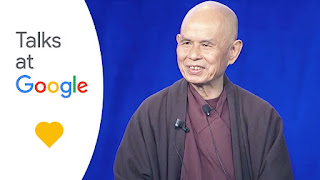
[3] Thich Nhat Hanh @ Google HQ: Loving Yourself / Four Mindfulness Exercises from the Buddha

Mindfulness as a Foundation for Wellness: Part 3

Click for Part 1 / Click for Part 2 Part 4 / Part 5

Source in the public domain of this video is HERE

Here is the continuation of the transcription of Thich Nhat Hanh’s talk at Google Headquarters of September 2011. This is what the great Zen teacher wanted most to convey to folks working at one of the world’s most dynamic and innovative tech companies. We can say, therefore, that it is Thich Nhat Hanh’s heartfelt message to us who live in a busy, hectic, and constantly changing world driven by the ubiquitous advanced technology that plays a crucial role in everything today. Special thanks to my research assistant Christine Atchison for helping me out in this

[27:40]

[1] Why loving and caring for yourself is the foundation of loving and caring for others

     That presence generated by the practice of mindfulness, of breathing [during] your walk, that presence is for you first (for us first), and then for the other person. We have to be truly present because love always begins with oneself. If you are not capable of loving yourself, of taking care of yourself, you will not have the capacity to love the other person and take good care of him or her. And that is why loving oneself is the foundation of loving the other person. And there are practices everyone can do in order to care for oneself, in order for us to be able to care for the other person and for the world. (28:45).

[2] Four Simple Meditation Exercises from the Buddha

[2.1] The First Exercise: Being Aware of Your In-Breath and Out-Breath

     The Buddha proposed many easy, simple practices that everyone can do. Like the first practice of mindful breathing [or] exercise of mindful breathing: Breathing in, I know I am breathing in. Breathing out, I know I am breathing out. You recognize your in-breath; you recognize your out-breath. And since you have your in-breath as an object of your mind you release everything else, you are free. A very simple exercise and in fact it’s great: it sets you free—just three, four seconds of breathing in. And you don’t need to practice many months and many years in order to see the effect. The first few minutes when you begin the practice you can see the outcome right away. Breathing in, if you pay attention only to your in-breath and then you can release the past, the future and all your projects (that is, pay attention to the present) and the process of healing begins right away.

[2.2] The Second Exercise: Following Your In-Breath and Out-Breath All the Way

     The second exercise on mindful breathing is: breathing in, I follow my in-breath from the beginning to the end. I follow my in-breath all the way through. Your in-breath may last only three or four, five seconds but while breathing in, you are fully concentrated on your in-breath and you may enjoy breathing in because breathing in is something enjoyable too. You don’t have to suffer while breathing in. If you suffer while breathing in, you are not practicing correctly.  Because life, there is a lot of suffering already in life, why do you have to practice in order to suffer more? So, whether it is the practice of mindful breathing, or mindful walking, or mindful sitting, we do it in such a way that it gives you pleasure and happiness. The practice is pleasant; [it] should be pleasant.

The Energies Generated by Mindfulness

     And when the energy of mindfulness and concentration is powerful enough, you always get an insight. The insight, that insight can help liberate you from your afflictions, like fear, anger, or jealousy, despair, and so on. There are three kinds of energies that can be generated by the practice of mindfulness. [1] The first energy is [the kind of] mindfulness which allow us to become alive, to become present in the here and the now and to be aware of what is happening in the here and the now. [2] And the second energy is the energy of concentration—when you are very aware, when you are very mindful of something, you are naturally concentrated on that. If you’re aware, if you are mindful of your in-breath, you get concentrated on your in-breath. So that is the meaning of the second exercise: breathing in I follow my in-breath all the way through. So mindfulness become powerful because of the concentration that is born from the practice of mindfulness. And when mindfulness and concentration are together, are powerful enough, you always get the third energy—[3] the energy of insight. (33:13).

The Miracle and Joy of Being Alive

     Insight in this case does not come from thinking, but from mindfulness and during the time of practicing mindfulness and concentration, you don’t need to think. You might like to stop the [process of] thinking all together. Insight has an outcome of non-thinking. When you breath in mindfully, and with concentration, you might discover many things. You might discover the fact that we are alive. Many do not know that they are alive. They are there but they are not alive because they do not have mindfulness. So, there is a very simple exercise: breathing in mindfully I feel alive. This is the truth—if someone is not alive, she cannot breath in anymore. So, breathing in mindfully, you get an insight that you are alive. And to be alive is the most wonderful thing. It is a miracle; it is the greatest of all miracles to be alive. And just two or three seconds [or] breathing in can bring you the insight that you are alive. And you touch the miracle of being alive and when you breath out you can celebrate the fact that you are alive.

     So, happiness is possible; joy is possible just by one in-breath and one out-breath. And it’s nourishing and healing. And breathing in mindfully like that helps you to touch the many conditions of happiness that have the power to heal and to nourish us and [those] around us. Suppose we breath in and we become mindful of our heart. Breathing in I am aware of my heart. Generating the energy of mindfulness, you use that image of mindfulness to recognize the presence of your heart. You kind of embrace your heart with the image/energy of mindfulness and you can discover the fact that your heart still functions normally. That is already an insight. And it’s wonderful to have a heart that still functions normally. There are those of us who are/can only wish for that, and their deepest desire might be just having a heart, a normal heart like that. So, breathing in and having our heart as the object of our mindfulness we can feel grateful to our heart and that is one of the conditions of happiness that we are having.

Being in Touch with our Body

     And when the Buddha teaches the practice of mindfulness of the body, he advises us to get in touch with parts of the body and smile, recognize these parts of the body. There is an exercise of deep, total relaxation that we will try today. We put ourselves in the lying position and we begin to breath in and out mindfully and recognize parts of our body. It’s like scanning our body not with an x-ray but with a ray of mindfulness. You recognize your eyes: breathing in I am aware of my eyes. Breathing out I smile with my eyes, recognizing the presence of your eyes. And you might get the insight that, well, my eyes are still in good condition. A paradise of forms and colours are easily available to me just because I still have eyes in good condition. You need only to open your eyes in order to touch the paradise of form and colour. That is another condition of happiness. And we go through the body, and we recognize every part of the body. And we come to a place that is a little failing we might like to stop longer and embrace with compassion and tenderness that part of the body that is ailing. That practice of being aware of the body can help heal the body. You can still continue with the medicine, but to relax our body, to embrace tenderly that part of our body with mindfulness practice can accelerate, can help very much [with] the healing, can make the healing happen more quickly. (39:31).

 [2.3/2.4] The Third & Fourth Exercises: Being Aware of Your Body and Releasing Tension

     The third exercise—breathing in I am aware of my body—is part of that exercise. And the fourth exercise is: breathing in, I release all the tension in my body. The body has the power to heal itself only if you allow it to do that. When an animal in the forest gets wounded, deeply wounded, she knows what to do. The animal finds a quiet place and lays down. She knows deeply that resting is the only way to heal. The animal does not think of looking for food or running after an animal. She knows that the best thing is to rest like that because the body has a natural tendency, a natural power to heal itself. We human beings used to have that kind of wisdom, but we have lost our capacity to rest. We have worked our body too hard. We have accumulated a lot of tension in our body and make it more difficult for our body to heal. We only count on medicines and other kinds of means. So, the fourth exercise of mindful breathing is very helpful. It helps us to be aware of our body and our mind become(s) embodied again and helps the body to release the tension. And when the tension is released, the body recovers that capacity to heal itself. So, the practice of mindful sitting with concentration, the practice of mindful walking, the practice of mindful breathing while lying down can be very helpful—it can heal.

The Role of the Sangha (the Community)

     And we do not have to set aside time in order to do that. Just as I said, walking from the parking lot to the office, you have time to practice releasing the tension and enjoying every step and in-breath and touching the Kingdom of God around you and inside of you. The only thing is that there should be someone to remind you to do it. You might understand it perfectly, but you don’t do it. We live as a community. Our root practice centre is in France, but in North America we have Deer Park Monastery in Southern California, Escondido. And we have the Brooklyn practice centre in the State of New York. And we live as a sangha of monks, nuns, and lay-practitioners and we practice together, and we remind each other to practice. When we listen to the bell, well hundreds of us listen to the bell together. When we sit together and work together, we do that together. And breathing together, walking together, sitting together, we generate a very powerful quality of energy of mindfulness, concentration, and compassion. (44:14).

     And that helps heal us. When you find yourself in an environment filled with that kind of energy—peace, mindfulness, compassion—you get the healing very easily and quickly. I think a corporation can organize [itself] also as a practice community. There are times when you can sit together, can breath together, can work together, release the tension together and then together we can generate that kind of collective energy that is very nourishing and healing. Our retreats of mindfulness are always attended by teenagers and children and there are practitioners who bring their babies (although the babies do not understand the Dharma Talk), they find themselves in an environment that is so peaceful, so compassionate, they get the nourishment, they feel it. So, everyone can profit from the practice.

     In the practice centre, when you need to move from one place to another place, you always apply the techniques of mindful walking no matter how short or how long the distance is. The practice is to arrive in the here and the now with every step and touching the wonders of life with every step. And while we walk, we do not talk, and we do not think. When we stop our thinking and our talking, we touch life more deeply so that we can get the nourishment and the healing. And when [gestures to the bell silently during a pause] let us enjoy breathing together. (46:49).

[the bell rings and the speaker and audience silently breath until 47:30]


---


Sunday, March 13, 2022

[2] Thich Nhat Hanh @ Google HQ: Walking Meditation / Cultivating Beauty, Stability, Right Perception, and Freedom

 Mindfulness as a Foundation for Wellness-Part 2

 (To go back to part 1, click HERE)

Part 3 / Part 4 / Part 5

from Talks at Google

SOURCE in the public domain HERE

Also on the ‘Talks at Goggle’ channel: https://www.youtube.com/watch?v=Ijnt-eXukwk&list=PLV7Diz4DTv4nv-RTpS-0QuDNHUh0b1OLP&index=1&t=6049s

Here is the continuation of the transcription of Thich Nhat Hanh’s talk at Google Headquarters of September 2011. This is what the great Zen teacher wanted most to convey to folks working at one of the world’s most dynamic and innovative tech companies. We can say, therefore, that it is Thich Nhat Hanh’s heartfelt message to us who live in a busy, hectic, and constantly changing world driven by the ubiquitous advanced technology that plays a crucial role in everything today. Special thanks to my research assistant Christine Atchison for helping me out in this.

***

[1] The Practice of Mindful Walking in Daily Life (15:24)

     Mindfulness allows us to be alive and to touch the wonders of life inside of us and around us and many of these wonders have the power to heal, to nourish. And you don’t have to go to a temple in order to practice mindfulness; walking from the parking lot to your office, you might enjoy the practice of mindful walking, you might like to enjoy every step. Touching the wonders of life, that is something that all of us can do.

     Years ago, we offered a retreat for a congressman from Washington, DC.  They have a hectic life and they need to practice mindfulness in order to release the tension, to relax and to be in touch with life. Many years after the retreat they continue to practice mindful walking and several of them wrote to us to say that from the office where they work to the place where they cast their vote, they always practice mindful walk[ing] and stop all thinking, just walk. They say that they survive that hectic life just by mindful walk[ing].

     So from the parking lot to your office, you might like to do like that—you stop all your thinking and you enjoy every step. Walk in such a way that every step can bring you freedom, can bring you solidity, freedom, and healing. Many of us even practice mindful walking to heal ourselves. When you breathe in mindfully and focus your attention on your breath, when you make a step mindfully and focus your attention on your step, you release the past, you release the future, you release all your projects because your mind has only one object -- that is your in-breath or your step. One in-breath or one step can set you free, free from the worries and the uncertainty about the future, free from the regret and the sorrow concerning the past. The past may be a prison, the future may be a prison if you are subjected to regret, sorrow, fear, uncertainty. But when you focus your attention on your in-breath, you release everything. So, one breath, one in-breath, sets you free. One step, made in mindfulness, sets you free. And when you are free your body has regained its power to heal itself and your mind also. (19:42).

[2] Four Helpful Mindfulness Practices and How They Help Us to Love Better (19:43)

Pebble Meditation – The First Pebble: a Flower (Beauty)

     I have said in the beginning that when you love someone you would like to offer him or her the best you have. The best, the most precious thing you have is your presence. But your presence may have a high quality. You are fresh, you are free, you are solid, you are happy. And the practice of mindfulness helps you to maintain your freshness, to cultivate more peace, more solidity. There is a practice called pebble meditation. There are four pebbles, and the practice goes like this: the first pebble represents a flower—breathing in I see myself as a flower; breathing out I feel fresh. The human me is a kind of flower. If we don’t know how to practice and then we will lose our freshness and we do not have much to offer the person we love. So, practicing mindful breathing or walking and restor[ing] your freshness, your floweriness, is something possible. Releasing the worries, the fear, the anger, and restor[ing] your freshness is something we can do while sitting or walking. But you can practice breathing in “I see myself as a flower,” you don’t have to imagine yourself as a flower because the human body, the human being, is very beautiful. It is a real flower. Look at a child: look at her face, her tiny hand, his tiny foot is a real flower. It’s beautiful when the child sleeps, it’s beautiful when the child is awake and play[ing] and we are born as flowers and it is possible for us to preserve our floweriness, our freshness, our beauty. (22:31).

The Second Pebble: a Mountain (Stability)

     The second pebble: breathing in I see myself as a mountain. A mountain represents stability and solidity. A person cannot be happy unless she has some stability, he has some stability. And the practice of mindful breathing, mindful sitting, mindful walking can always help us to contemplate more stability and solidity. And our solidity, our stability, is something we can offer to the person we love. If you are too unstable, if you are not solid, you are not happy and you cannot, and the other person suffers also because of that. So contemplating stability and solidity is something you can do.

The Third Pebble: Still Water (Right Perception)

     Breathing in I see myself as still water, breathing out I reflect things as they truly are. When you are calm you are not victims of wrong perceptions, you are not victims of anger and fear because you are calm enough—you don’t imagine things. So, breathing in, breathing out, practicing walking, you can contemplate peace, calmness, tranquility. A person who does not have enough peace in himself, herself, cannot be a happy person. So contemplating peace in oneself is something we can do with the practice of mindful breathing, mindful walking, mindful sitting. And when you have peace in you, you have something to offer him or her [the one you love].

The Fourth Pebble: Space (Freedom)

Breathing in I see myself as space, breathing out I feel free. If you do not have enough space in the heart (we have so many worries and fear and anger), we are not happy. And that is why the practice is to bring more space into our heart and around us. A person cannot be a happy person unless she has some freedom, some space in herself or around her. So, to love means to offer space. And if you do not have space in you how can you offer your beloved one with space? That is why the practice of mindfulness—whether that is mindfulness of breathing or walking, working, or eating—always helps us cultivate these values, these energies. We can cultivate our beauty, our freshness; We can cultivate more our stability and solidity, we can cultivate more the energy of peace, calmness, and we can always cultivate more the element of freedom in us. So, when you look at your beloved one and you say ‘darling, I’m here for you’ that is a great gift because your presence has an element of freshness, of stability, of peace, and of freedom—the best kind of gift you can make to him or to her. (27:07).

[Gong rings. Then silence until 27:40.]

---

Tuesday, February 15, 2022

[1] Thich Nhat Hanh @ Google Headquarters: Mindfulness, Mind & Body, Love & Presence

 Mindfulness as a Foundation for Wellness-Part 1

SOURCE: https://www.youtube.com/watch?v=W3QFc5IX5qo&list=WL&index=12&t=1982s

I think that transcribing important talks and lectures of great teachers is very important for us to be able to return to them as texts and get a better overall grasp of the lecture’s structure as well as the most important points the teacher emphasized. Here, I offer the transcription of Thich Nhat Hanh’s talk at Google Headquarters of September 2011. One can imagine that this is what the great Zen teacher wanted most to convey to folks working at one of the world’s most dynamic and innovative tech companies. We can say, therefore, that it is Thich Nhat Hanh’s heartfelt message to us who live in a busy, hectic, and constantly changing world driven by the ubiquitous advanced technology that plays a crucial role in everything today. Special thanks to my research assistant Christine Atchison for helping me out in this. [jkk – I’ve added some summary points after each section called “Note Well”]

[1] On the power of the bell and the energy of mindfulness [00:00 – 01:59]

     Dear friends, in Plum Village France (Thay’s monastery) where we live and practice, every time we hear the sound of the bell we stop our thinking; we stop our talking, and we go to our in-breath and breathe mindfully. And, at least three times … in … out, and that practice is called listening [to] the bell, the sound, mindfulness. When you hear the bell, you naturally stop your thinking . . . it has become a habit. You naturally stop your thinking and you focus your attention on [your] in-breath and you enjoy breathing in. And when you breath in mindfully like that you bring your mind home to your body and you become fully alive in the here and the now.

     It takes only three seconds in order to bring the mind home to the body and establish ourselves in the here and the now. And when you are well-established in the here and the now you can [get] in touch with life: first of all, with your body, your feelings, your perceptions, your mental formations, your consciousness. And you get in touch with the oneness of life around you. The energy of mindfulness has the power to heal, to transform.

---

[2] On love, meditation, and mindfulness: How to be present in the here and the now for your beloved one  

Mindfulness and Love [02:00 – 04:10]

     When you love someone, you have the tendency to offer him or her something; you want to make him or her happy. And, you are inhabited by the energy of love and that is why you have the desire to make him or her happy. As I have said, love has the power to heal, to nourish, to bring happiness, and to transform suffering. And the practice of mindfulness can produce love. The elements of true love can be produced by the practice of mindfulness and when you have that love in you, you are alive; you are peaceful; you are happy; and you can make the other person happy.

The True Gift of Love is One’s Presence [04:11~07:25]

     Usually, when we want to make the other [another] person happy we want to give him or her something. We might write a poem for him or her, or we might cook something good and give it to him or to her or you might go to the market and buy something. But the most precious thing you can give him or her is not something you can buy from the market. It’s not something that you can buy with money: it’s your true presence.

     You have to be there, for him and for her, if you truly love him or her. And in order to be there you need the practice of mindfulness. And what you want [to] offer your beloved one is your true presence. How can you love if you are not there? To love means to be there for him or for her and to be there is a practice.

     In the Buddhist tradition, when you begin to breathe in mindfully you bring your mind home to your body and when mind and body are together you are truly there. In our daily life, very often our body is there but our mind is not there. We are not truly there. It’s impossible to love if you are not there. So, practice mindful breathing, bring your mind home to your body—it can help you to be there. Our in-breath, our out-breath is something like a bridge linking mind and body and the moment we pay attention to our in-breath and breath in mindfully we bring our mind home to our body and we are there in just two or three seconds. And, you can look, you can go to your beloved one looking in his eyes, her eyes, and you can say ‘darling, I’m here for you’. Your presence is the most precious give that you can make to your beloved one. (7:25).

     There is an eleven-year-old boy who is unhappy because his father is not there for him. His father is a very rich businessman; successful business man too. But he does not have time for himself, for his wife and his son. One day he said ‘my son, tomorrow will be your birthday right? Do you want anything? I will buy it for you’. The young man did not know how to answer; he did not need anything. His father can afford to buy anything he wants, but he did not need anything. He needed one thing—the presence of his father. From time to time, his father is there at home but his mind is not with his body. So, the young man has the impression that he does not really have a father. So, after some reflection he said ‘Daddy, it’s you that I want’.

     And if the father knows the practice of mindful breathing he will begin to breath in mindfully and it takes only three seconds for him to be there, body and mind together, and look into the eyes of his son and say, ‘Darling, I’m here for you’. It’s very easy, everyone can do that. To me, to love means to be there for your beloved one. And to be there, for me, is not an intention, a desire—that is a practice. In order to be there, you need to breathe in mindfully and bring your mind home to your body. Or you might like walking meditation—mindful walk. While breathing in you make one step, out two steps, and you become aware of the step you make: You are touching life in the present moment with your foot. One step alone can bring you home to the here and the now and be fully present in the here and the now. There are many ways of practice that can help bring our mind home to our body so that we can be established in the here and the now. (10:34).

NOTE WELL

  • “Being there” is not an intention or a desire. It is a practice!
  • Concretely, in order to “be there” (to be present in the here and now), do mindful breathing; bring your mind home to your body.

·   [3] On Practicing Mindfulness and Touching the Kingdom of God [10:34-15:23]

     When you breathe in mindfully and look at the flower, like this one, you have an opportunity to get in touch with this flower deeply. You are mindful that the flower is there. Mindfulness is the kind of energy that allows us to know what is there—what is happening in the here and the now. When you practice mindful breathing the object of your mindfulness is your in-breath. Your in-breath is something that is happening in the here and the now and you might enjoy your in-breath. Also, when you breath-in and—using the image of mindfulness generated from your in-breath—you can recognize that flower as existing and you get in touch with that flower. And if your mindfulness is strong enough, powerful enough, you get concentrated on the flower and you get insight that that flower is a wonder—a wonder. And, you may see that the flower belongs to the Kingdom of God [or] of the Pure Land of the Buddha. And when you get in touch with the flower you get in touch with the Kingdom of God and you get in touch with God because God is always with his Kingdom. And you may get insight that the Kingdom of God is available in the here and the now—you don’t have to go and look for it in the future or somewhere else. You don’t need to die in order to go to the Kingdom. In fact, you have to be very alive in order to do so and to be alive, to be fully present in the here and the now, you need only to breathe in mindfully. It takes only two-to-three seconds.

     So now the Kingdom of God is available to you because you have the power, the capacity of being mindful. And the insight you get is the Kingdom is available in the here and the now and you would like to make yourself available to the Kingdom. And to make yourself available to the Kingdom, that can be done very quickly, just breath in mindfully or make a step mindfully. And then when you practice breathing in, “I am aware of my body”. This is the third exercise recommended by the Buddha in the sutra on mindful breathing—breathing in ‘I’m aware of my body’. Mindfulness of the body, you know that your body is there and while breathing in like that you bring your mind home to your body and there you are, alive, present, and you might discover that your body also belongs to the Kingdom of God. Your body, like that flower, is a wonder and you can touch the Kingdom of God also in your body. You don’t have to go far and in the future in order to get in touch with the Kingdom of God.

NOTE WELL

  • You can direct your mindfulness (through the practice of mindful breathing) to particular objects, like a flower or your body
  • When you do so, you realize more deeply that these objects are wonders
  • Moreover, you realize that each and every thing belongs in the realm of the Sacred. Thus, by the simple practice of mindfulness through breathing, you can touch the realm of the Sacred (“the Kingdom of God”, or “the Pure Land”)

---


Sunday, November 28, 2021

A Powerful Experience from When I was Ordained a Deacon in Rome


My Pre-Diaconate Exam

I was ordained a deacon in Rome in June of 1994. I was then a member of a religious order, the Salesians of Don Bosco, and I became a deacon as part of my ministry as a Salesian. Rome is a special place to be ordained a deacon obviously because it’s the pope's very own diocese. We candidates had to take a special oral interview-exam for the diaconate conducted by professors coming from different Roman pontifical universities. This was the last hoop to be cleared before one was ordained in the pope's diocese. The exam was to take place at the Lateran University because that is the university of the local church of Rome. So we prepared for the exam and went to the Lateran University bright and early on the specified date.

When my turn to be examined came, I was directed to the exam room. There was a priest-professor waiting for me. I found out later that he was the rector of the North American College in Rome. I don't remember his name but, looking at the list of rectors online, he must have been then-Fr. Edwin O'Brien (later archbishop of Baltimore). His first question to me was a totally unexpected one: What is ontology?

I was blindsided by the question because, to my mind, it apparently had nothing to do with being ordained a deacon. But I duly answered him and explained what I thought ontology was: that it was examining the nature of reality and the totality of things in existence. I think I also went on about ontology as the study of 'being' and what constitutes a being as the word "ontology" comes from the Latin "ens" which means precisely "being."

Having listened patiently to my explanation, he proceeded to his second question which was even more baffling to me. He asked , "What’s the connection between ontology and being a deacon?"

The So-Called "Ontological Change"

As soon as I heard that, I immediately grasped what he was getting at. So, I calmed down and started to explain that being ordained a deacon means having, as it were, a spiritual "seal" seared into your very being, because standard Roman Catholic sacramental theology  teaches that the sacrament of ordination effects a character upon the people who receive them. To use a fancy yet traditional expression, the sacrament of holy orders effects--what Roman Catholic theology calls--an "ontological change" (a transformation in the person's very being) whereby the person is given an ontological character which changes them into the very thing that the sacrament signifies.

Baptism is another of these "character-giving" sacraments because it bestows an irrevocable seal, a mark on your soul that transforms you into a child of God. After all, baptism is the sacrament of initiation which transforms people--it is believed--into children of God. When you receive the sacrament of ordination (and there are three kinds: diaconal, presbyteral [priestly], and episcopal), Roman Catholic theology teaches that you are given the "ontological character" (a character that constitutes your very being) of what the particular sacrament signifies.

The Heart of Becoming a Deacon - Becoming a Servant Forever

In the case of the ordination to the diaconate, the ordinand is, therefore, marked with the "ontological character" of a deacon. And what is that character, one may ask? It is to be a servant, one who devotes oneself to the service of the Christian community, particularly in the service of proclaiming the word and offering a few sacraments and ministries that would serve the community.

As I went on explaining the connection between "ontology" and "ordination" along those lines, it seemed that the good father realized that I knew my theology and so he stopped me and said in a solemn yet calm voice,  "Do you know why I asked you those questions?"

Without waiting for my answer, he proceeded to answer his own rhetorical question. What he said struck me powerfully and I have never forgotten it to this day. He said that many candidates for ordination think that being ordained a deacon is just the penultimate stage on their path to being ordained a priest because the diaconate in the Catholic Church is still generally a "transitional" stage. That means: it is mostly conferred on men who are eventually going to be ordained as priests. My priest-examiner said that this lack of mindfulness about the diaconate is a lamentable fact because very few priests remember that, when they were ordained deacons, they were in fact given a character which remains irrevocably embedded in their souls for life. And that character is, as I said, to be a diakonos, a servant. In short, when one is ordained a deacon, one is transformed irrevocably into a servant forever because the sacrament effected this so-called "ontological" change! Hence, even if one does become a priest one day, one should never forget that one is and should always and in all cirumstances be, first and foremost, a servant.

Reflections in Retrospect

I remember quite clearly those memorable words of the priest-examiner before my ordination to the diaconate as if they were yesterday. I did get ordained to the diaconate shortly after that at the Sacred Heart Basilica just beside Rome's central train station Termini. It was a joyous and memorable occasion particularly because my father flew all the way from Asia to attend it. I was surrounded by dear friends who wished me well. I served as a deacon for a whole year, most of the time at the very basilica where I was ordained a deacon. A year later in 1995, I was ordained a presbyter (priest)  this time in--what was then my home base--Tokyo, Japan.

Fast forward now some 25 years later to myself in 2021. I no longer have the official "faculties" (a kind of a "license") to practice formally as a deacon or a priest at present due to circumstances that I will not bore you with now.  I still do remember though with a grateful heart what the priest examiner told me before I was to be ordained a deacon. I don't think that the "ontological change" language is helpful anymore though. It kind of sounds arrogant and narcissistic to me. However, if you describe the diaconate as being "sealed with a character of service," I still find that symbolic language quite powerful. I have always striven to be true to that mission and that character which I gratefully received then and continue to cherish even now.

In the final analysis, what is ordination anyway? It is a sacrament conferred on a select few in order to symbolize more intensely the true nature of the Christian community and of every member thereof: a servant, a minister, a mediator like Jesus between God and one's fellow humans, a shepherd like Jesus who takes care of those under one's charge to the point of being willing to offer one's life for them. 

The nature and mission of the so-called "ordained" state therefore are not the exclusive property of ordinands, some of whom like to strut around like peacocks because of their different so-called "ontological" state. I find that attitude quite silly. They belong rather to the whole body of Christ and they ought to be conferred--I firmly think--on any Christian, irregardless of sex or marital status, who is willing and qualified. That's what I honestly think today and, in large part, that is in line with the practice of the early Church. 

The ultimate argument though for me is this: If someone can bear the image of God and of Christ (and that again is not dependent on sex or marital status), they can be rightfully empowered to represent God-Christ in a more intense way through ordination to the munus triplex (the threefold role) of "prophet, priest, and servant-king." Any quibbling about that is--I think--nothing but attachment to a patriarchal past rather than genuine openness both to tradition and to the "spirit at work in the world" today.

---